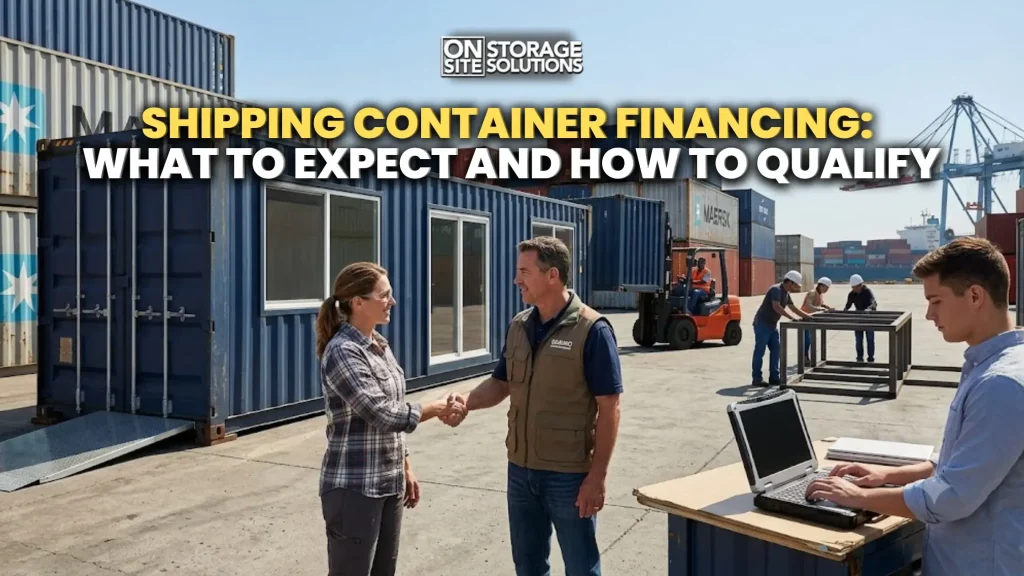

Shipping container financing is becoming a preferred method for businesses and individuals who need fast access to storage and workspace solutions without the limitations of traditional lending systems.
This model shifts focus away from credit scores and toward real business performance, making it easier to secure essential assets like a shipping container for operational use.
At the center of this shift is flexibility, speed, and accessibility, especially through rent-based ownership structures that allow users to scale without large upfront capital.
Key Takeaways
- Shipping container financing prioritizes cash flow over credit history
- Approval is based on bank activity, income stability, and payment ability
- Rent-based models allow users to use now and own later
- Standard shipping container sizes are easier to finance than modified units
- Monthly payments are structured to support small business cash flow
- Monthly payments are structured to match small business cash flow, while rent-to-own models reduce upfront cost pressure through predictable installments.
- Industries like construction, retail, agriculture, and logistics benefit most
What Shipping Container Financing Actually Means
Shipping container financing is a structured payment solution that allows users to acquire a shipping container without paying the full cost upfront.
Instead of a traditional loan process, approval is based on financial behavior such as:
- Monthly revenue consistency
- Business bank activity
- Ability to sustain recurring payments
This model is designed for individuals and businesses that need storage capacity immediately but prefer to spread costs over time.
Unlike conventional lending, approval decisions are more focused on current financial strength rather than past credit performance.
How Approval Works in Shipping Container Financing
The approval process is simplified to reduce delays and increase accessibility.
Typical process flow:
- Select required shipping container size and type
- Submit basic business or personal financial details
- Provide bank activity or income verification
- Review structured payment plan
- Receive approval and delivery schedule
Approval is primarily based on:
Factor | Why It Matters |
Cash flow consistency | Shows ability to pay monthly obligations |
Bank deposits | Indicates active financial operations |
Business stability | Reduces financing risk |
Payment history behavior | Predicts repayment reliability |
This approach opens access more widely than traditional bank loans by removing strict lending barriers and focusing on practical affordability.
Rent-to-Own Structure in Shipping Container Financing
A major component of shipping container financing is the rent-to-own model.
With rent to own storage containers, users:
- Pay fixed monthly installments
- Use the shipping container immediately after delivery
- Gain ownership after completing all payments
This structure eliminates the need for large upfront investment while still building toward asset ownership.
Common rent-to-own terms:
Term Type | Typical Range |
Payment duration | 12 to 48 months |
Container sizes | 20ft and 40ft shipping container units |
Ownership transfer | After final payment |
This model is widely used by businesses seeking predictable expenses and long-term asset control.
Who Qualifies for Shipping Container Financing
Shipping container financing is designed for applicants with active financial movement rather than perfect credit history.
Common qualifying profiles include:
- Construction contractors using shipping container units for job site storage
- Retail businesses managing overflow inventory
- Agricultural operators securing equipment and supplies
- Startups needing scalable storage solutions
- Logistics and transport businesses requiring mobile storage
Many applicants also use rent container storage solutions as an entry point before transitioning into full ownership models.
Container rent to own structures are especially useful for first-time buyers who want predictable payments while building long-term ownership.
Cost Expectations for Shipping Container Financing
Costs vary depending on container size, condition, and payment structure.
General pricing breakdown:
Container Type | Cost Structure | Use Case |
20ft shipping container | Lower monthly payments | Small storage or business use |
40ft shipping container | Higher capacity, moderate payments | Large inventory or equipment storage |
Rent-to-own plans | Fixed monthly payments over term | Ownership-focused users |
Container financing spreads cost over time, allowing businesses to maintain liquidity while acquiring essential infrastructure.
Compared to traditional financing, this model reduces upfront capital requirements and improves cash flow planning.
Why Approval Is Easier Than Traditional Financing
Traditional lending relies heavily on credit scoring, which limits access for many businesses.
Shipping container financing removes that barrier by focusing on:
- Real-time income flow
- Operational stability
- Payment capability
This shift makes approval more accessible for applicants with:
- Limited credit history
- Rebuilding credit profiles
- New or growing businesses
The goal goes beyond fast approval, focusing instead on making essential equipment accessible to businesses based on real operational needs, not credit limitations.
Strategic Advantages of Shipping Container Financing
Shipping container financing supports modern business needs by offering:
- Faster access to a shipping container
- Flexible repayment structures
- Reduced upfront financial burden
- Scalable storage solutions
It is especially effective in industries where storage demand changes quickly and infrastructure must adapt.
Container rent to own models further enhance this flexibility by combining usage and ownership into one structured pathway.
How On-Site Storage Solutions Supports Shipping Container Financing
Shipping container financing becomes easier when access to storage is fast, flexible, and simple.
On-Site Storage Solutions offers shipping container units through flexible payment options like container rent to own, allowing customers to use the container immediately and pay over time toward ownership.
This approach supports businesses, contractors, and startups needing quick storage without large upfront costs, including those exploring rent container storage and rent to own storage containers.
It aligns with modern shipping container financing by focusing on speed, access, and affordability instead of strict credit requirements.
For more information or assistance, reach out to On-Site Storage Solutions at (888) 977-9085 to explore available storage options.
FREQUENTLY ASKED QUESTIONS
Qualification is often based on cash flow instead of credit history. Lenders usually review bank deposits, income consistency, and overall business activity. Even applicants with low or limited credit can still qualify if they show stable financial movement and the ability to make monthly payments.
Most approvals require basic business or personal information, proof of income, and bank activity records. Instead of strict credit checks, providers focus on payment ability and financial stability. Some programs also allow faster approval through simplified documentation.
Leasing is better for short-term use, while financing or rent-to-own is better for long-term ownership. Financing allows you to pay over time and eventually own the shipping container, while leasing typically requires ongoing payments without ownership.
A rent-to-own plan allows you to use the shipping container immediately while making monthly payments. Once all payments are completed, ownership is transferred to you. This makes it easier to access storage without large upfront costs.
Monthly payments depend on container size, condition, financing term, and payment structure. Longer terms usually lower monthly costs, while shorter terms increase payments but reduce total cost over time.