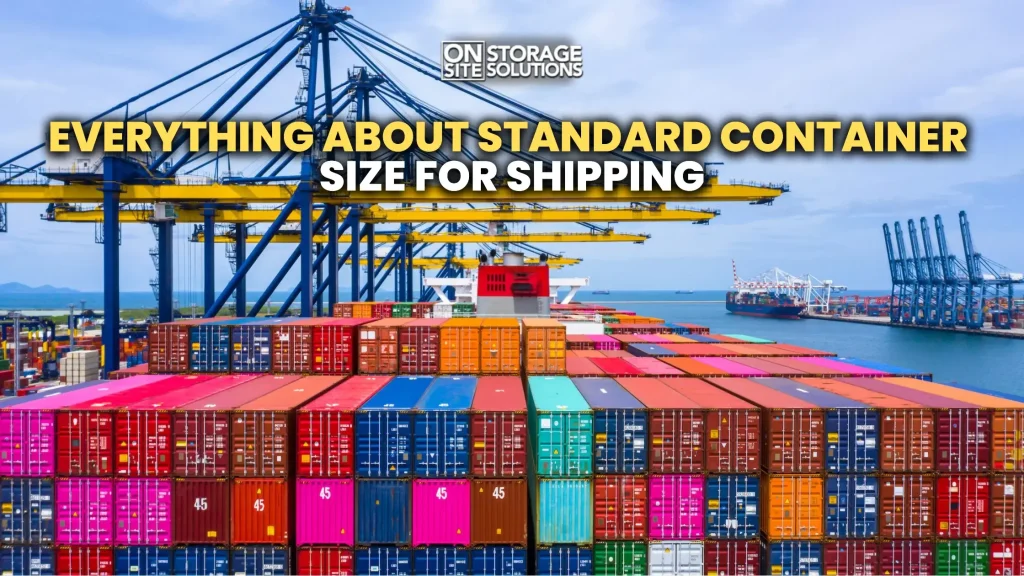

In worldwide shipping, using the standard container size for shipping is crucial. These containers are built strong to protect goods from the elements and ensure they arrive safely. Beyond being watertight, their standardized sizes allow them to be easily loaded on cargo ships, trucks, and trains, and efficiently handled at ports around the globe.
With consistent dimensions, businesses can plan shipments, stack containers securely, and move cargo faster than ever.
These containers are not only practical but also cost-effective, helping companies save time and money while maintaining the safety of their goods.
What Is a Standard Shipping Container?
An ISO shipping container, also called an intermodal container, is a large steel box designed to transport goods globally via ships, trains, or trucks. The standard container size for shipping ensures uniformity in size and shape, allowing for easy loading, unloading, stacking, and transport while keeping cargo secure. Each container comes with a CSC plate, certifying it meets international safety standards.
Commonly, these containers measure 20 feet in length, though 40-foot variants exist. With corrugated steel walls, wooden flooring, and double doors at one end, these containers provide convenient access. The introduction of standard shipping containers, complete with CSC certification, revolutionized global trade by making shipping more efficient and secure.
Today, companies worldwide rely on them to move goods safely and economically. Many industries, from retail to manufacturing, depend on these containers to maintain a steady supply chain.
A Short Overview of the Shipping Container’s History
The idea of shipping containers started in the 1950s when businesses sought faster and more efficient methods for moving goods. Malcolm McLean, an American entrepreneur, introduced the intermodal shipping container in 1956, transforming global logistics. His concept of steel containers simplified loading and unloading at ports, drastically reducing time and labor.
Over time, the standard container size for shipping became widely adopted, helping global trade function smoothly and reliably. The innovation of containerized shipping also encouraged the development of modern ports and intermodal transport networks, further boosting global commerce.
Standard Container Size for Shipping
Standard and High Cube shipping containers come in 20 ft and 40 ft sizes, providing flexibility for various types of cargo. Here’s an overview of the most common dimensions and capacities:
Standard Container Size for Shipping – 20 ft vs 40 ft
Standard 20 ft Shipping Container
- Dimensions: 20 ft L × 8 ft W × 8.5 ft H
- Capacity: ~1,170 cubic feet
- What Fits:
- About 10 standard pallets
- Small vehicles like sedans or SUVs
- Household items for a 1–2 bedroom apartment
- Office equipment or small-scale retail inventory
- About 10 standard pallets
Standard 40 ft Shipping Container
- Dimensions: 40 ft L × 8 ft W × 8.5 ft H
- Capacity: ~2,390 cubic feet
- What Fits:
- About 21 standard pallets
- Larger vehicles or multiple cars
- Household items for a 3–4 bedroom house
- Bulk goods or industrial supplies
- About 21 standard pallets
Standard Container Size for Shipping – High Cube Options
High Cube 20 ft Shipping Container
- Dimensions: 20 ft long × 8 ft wide × 9 ft 6 in high
- Capacity: ~1,320 cubic feet
- What Fits:
- Taller items or machinery
- Extra height for stacking pallets
- Equipment requiring vertical space
- Oversized household items or specialty equipment
- Taller items or machinery
High Cube 40 ft Shipping Container
- Dimensions: 40 ft long × 8 ft wide × 9 ft 6 in high
- Capacity: ~2,680 cubic feet
- What Fits:
- Large machinery or construction equipment
- Increased vertical clearance for stacked items
- Efficient loading and unloading of tall cargo
- Multiple types of cargo combined in one container
- Large machinery or construction equipment
Using the standard container size for shipping ensures consistent handling, easier logistics planning, and compatibility with intermodal transport systems worldwide. These containers also make international trade more predictable, allowing businesses to calculate shipping costs and optimize storage space efficiently.
Additionally, their shipping container strength allows them to withstand harsh conditions during transit, ensuring goods arrive safely.
Benefits of Standard Container Size for Shipping
Standardized containers bring many advantages:
- Efficiency: Loading, unloading, and transport processes are simplified.
- Safety: CSC certification ensures containers meet international standards.
- Flexibility: Various sizes accommodate small household items to large machinery.
- Cost Savings: Faster handling reduces labor and shipping time, saving money. Low cost shipping containers make storage affordable.
- Durability: Made from high-quality steel, containers can withstand harsh conditions during transport.
On-Site Storage Solutions
At On-Site Storage solutions, we provide a wide selection of standard container size for shipping to meet your storage and transportation needs. Whether you need secure on-site storage or help transporting goods, our team is ready to assist.
With our containers, you can expand storage space or move cargo efficiently. Our containers are also easy to customize with shelving, ramps, or security features to suit your specific requirements.
Contact us today at (888) 977-9085 to explore our range of containers and find the perfect solution for your requirements.
amcorper mattis, pulvinar dapibus leo.
FREQUENTLY ASKED QUESTIONS
The standard container size for shipping typically comes in 20 ft and 40 ft lengths, both 8 ft wide and 8 ft 6 in high. High Cube variants add extra height of 9 ft 6 in for taller cargo or stacked goods.
A standard 20 ft container measures 20 ft long × 8 ft wide × 8 ft 6 in high. It can hold approximately 1,170 cubic feet of cargo, such as 10 pallets, small vehicles, or household items for a 1–2 bedroom apartment.
A standard 40 ft container measures 40 ft long × 8 ft wide × 8 ft 6 in high. It can hold roughly 2,390 cubic feet of cargo, including multiple vehicles, 21 pallets, or household goods for a 3–4 bedroom home.
International shipping commonly uses standard 20 ft and 40 ft containers. These ISO-certified containers fit cargo ships, trucks, and trains, ensuring safe, efficient, and uniform handling of goods worldwide across different transportation modes.
The primary difference is length and capacity. A 20 ft container holds about 1,170 cubic feet, while a 40 ft container holds approximately 2,390 cubic feet. Both have the same width and height, but 40 ft containers accommodate more cargo and larger items.


