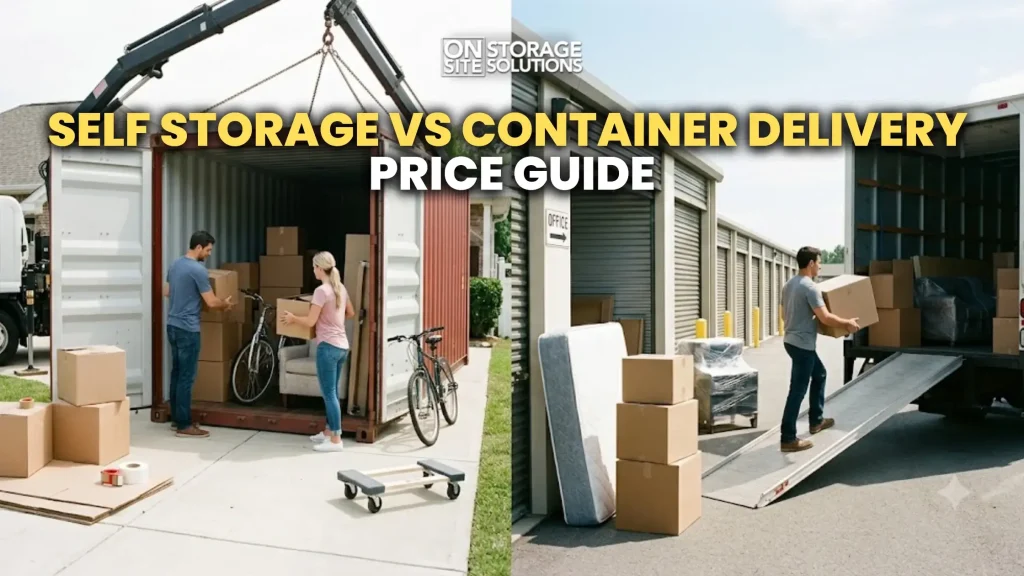

Container delivery is reshaping how homeowners evaluate storage costs because the real price of storage is no longer defined by monthly rent alone. Transportation, labor, access frequency, and project timing all shape the actual total cost.
Most comparisons focus only on advertised rates. That approach ignores the operational expenses that accumulate during moves, renovations, and temporary relocations.
This guide breaks down the true price comparison between self storage and container delivery, using real market pricing, cost tables, and total value analysis so homeowners can make financially informed decisions.
Key Takeaways
- Self storage units usually appear cheaper but often carry hidden transportation costs
- Container delivery reduces trips, labor, and vehicle rental expenses
- Total cost depends heavily on storage duration and access frequency
- Short term projects usually favor container based storage solutions
- Long term low access storage typically favors traditional self storage
- Labor and logistics often impact final cost more than monthly rent
- Real savings come from evaluating total ownership cost, not base price
Self Storage vs Container Delivery: Core Operational Difference
A self storage unit is a dedicated storage space located within a commercial facility, where items are kept off-site and accessed by the renter as needed. Homeowners must transport belongings to the site, unload them, and return whenever access is needed.
A container delivery service brings a storage container directly to the property. Homeowners load items at home, after which the container is either stored on site or transported to a secure facility.
This structural difference changes how costs accumulate. One model separates transportation and labor. The other integrates them into a single service.
A portable storage container company simplifies logistics by combining storage and transport into one system instead of multiple independent steps.
Real Market Pricing: Container Delivery Cost Breakdown
Container pricing varies based on size, delivery distance, and rental duration. Larger units provide more space but increase transport requirements.
Container Delivery Rental Price Table
Container Size | Average Monthly Rental | Delivery & Pickup Fee |
10ft Container | $75 to $150 | $75 to $200 |
20ft Container | $100 to $250 | $100 to $350 |
40ft Container | $150 to $350 | $150 to $500 |
Additional costs may include storage yard fees, extended rental charges, or weather protection add ons.
Storage container transport costs increase when access is limited, distances are long, or placement conditions require specialized equipment.
A shipping container used for residential storage is designed for durability, but pricing still depends on handling logistics and delivery complexity.
Real Market Pricing: Self Storage Unit Cost Breakdown
Self storage pricing is influenced by location, demand, and facility type. Urban areas typically have higher rental costs compared to suburban locations.
Self Storage Unit Price Table
Unit Size | Average Monthly Price |
5×5 Unit | $50 to $90 |
5×10 Unit | $70 to $130 |
10×10 Unit | $110 to $180 |
10×20 Unit | $180 to $300+ |
Climate controlled units increase pricing by 10 to 25 percent depending on region.
These prices do not include transportation, truck rental, fuel, or labor costs, which are required for move in and move out.
Hidden Costs That Impact Container Delivery Pricing
The most overlooked storage costs are not visible in monthly pricing.
Self storage requires repeated transportation, which introduces multiple expense layers:
- Truck rental fees
- Fuel and mileage costs
- Multiple loading trips
- Packing labor or movers
- Time based opportunity costs
With container delivery, these expenses are significantly reduced because storage comes directly to the home, eliminating repeated travel.
This is where the real cost gap begins to appear.
Transportation Cost Comparison
Cost Factor | Self Storage Unit | Container Delivery |
Truck Rental | Required | Not Required |
Fuel Costs | Multiple Trips | Included |
Loading Trips | Repeated | Usually One |
Access Transport | Self Managed | Included Service |
Self storage separates transportation from storage. Container delivery integrates both into one system.
This difference becomes most significant during active projects where repeated access is required.
Labor and Time Cost Comparison in Container Delivery
Labor cost is one of the most underestimated storage expenses.
Labor Factor | Self Storage Unit | Container Delivery |
Loading Sessions | Multiple | Usually One |
Moving Assistance | Often Required | Reduced Need |
Packing Flexibility | Limited | Flexible |
Time Investment | High | Lower |
A portable storage container company reduces handling frequency, which lowers physical labor and time consumption during moves or renovations.
Time savings directly translate into financial savings for homeowners managing tight schedules.
Total Cost of Ownership: Real Comparison
This is where pricing becomes meaningful.
Example Scenario: 2 Month Storage Project
Self Storage Unit Total Cost
- Unit rental: $300
- Truck rental: $150
- Fuel: $80
- Labor help: $250
- Total: $780
Container Delivery Total Cost
- Container rental: $400
- Delivery and pickup: $250
- Reduced labor: $0 to $100
- Total: $650 to $750
Even when monthly rent appears lower for self storage, total cost often becomes higher due to transportation and labor requirements.
Container Delivery Cost by Storage Duration
Storage Duration | Best Value Option | Reason |
Under 3 Months | Container Delivery | Lower logistics cost |
3 to 6 Months | Container Delivery | Fewer trips required |
6 to 12 Months | Depends on access frequency | Mixed cost drivers |
12+ Months | Self Storage Unit | Lower recurring rent |
Short term projects amplify transportation inefficiencies in self storage, making delivered storage more cost effective.
Long term storage reduces transport frequency, giving self storage a cost advantage.
Container Delivery Property Access and Practical Constraints
Storage choice is also influenced by physical and regulatory conditions.
Factor | Self Storage Unit | Container Delivery |
On Site Access | No | Yes |
Travel Requirement | Yes | No |
HOA Restrictions | None | Possible |
Driveway Requirement | No | Yes |
Container placement depends on available space and local rules. Self storage avoids these limitations but introduces travel requirements.
Climate Protection and Storage Value
Environmental protection affects long term cost efficiency.
Self storage facilities often offer climate controlled units that protect sensitive items from humidity and temperature changes.
A shipping container offers strong exterior durability but may require internal moisture control depending on climate conditions.
Feature | Self Storage Unit | Container Delivery |
Climate Control | Common | Limited |
Weather Resistance | Indoor Protection | High Exterior Strength |
Moisture Control | Managed | User Dependent |
Alternative Storage and Long Term Value
Some homeowners consider alternative storage solutions that build long term value instead of recurring rental cost.
These include permanent structures such as sheds, garages, or built in storage spaces that increase usable property area.
This approach shifts storage from an expense model to a potential equity building investment.
Container Delivery Made Simple for Homeowners
Container delivery removes the complexity of traditional storage by bringing the storage unit directly to your property. Instead of coordinating trucks, loading schedules, and multiple trips, everything happens in one place.
For homeowners planning moves, renovations, or temporary storage, this approach reduces both time and logistical pressure while keeping belongings accessible when needed.
On-Site Storage Solutions provides reliable container delivery services designed to simplify storage from start to finish. The container is delivered, loaded at your pace, and picked up when ready.
Call (888) 977-9085 to request a quote and compare your actual total cost in minutes.
FREQUENTLY ASKED QUESTIONS
Container delivery is a storage service where a container is delivered directly to a homeowner’s property. The container is loaded on-site, then either stored at the location or transported to a storage facility.
This eliminates the need for truck rentals and multiple trips to a self storage facility.
Container delivery can be more cost effective for short term storage because it reduces transportation, fuel, and labor expenses.
Self storage may be cheaper for long term storage when there is little or no need for frequent access or relocation.
Most container delivery pricing includes:
- Container drop off to the property
- Monthly rental fee
- Pickup and return service
Some providers may also include storage container transport to a secure warehouse if off-site storage is required.
Additional costs may apply for long distance delivery or extended rental periods.
The cost of container delivery depends on container size and location.
Typical monthly pricing includes:
- 10ft container: $75 to $150
- 20ft container: $100 to $250
- 40ft container: $150 to $350
Delivery and pickup fees are usually charged separately depending on distance and access conditions.
Yes. Container delivery is highly effective for moving and renovation projects because homeowners can load items gradually at their own pace.
It reduces stress from strict truck rental timelines and eliminates repeated trips to a storage facility.