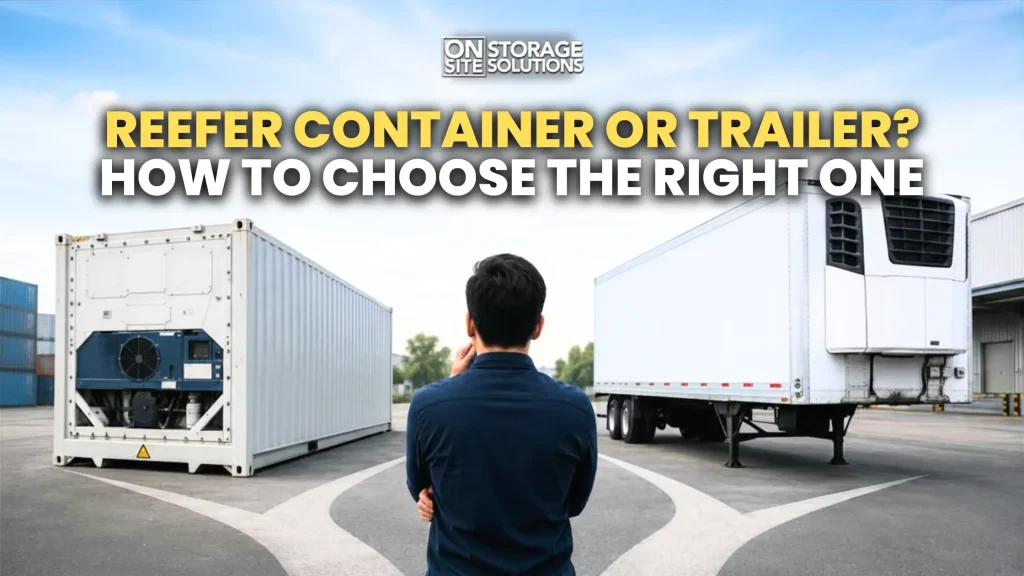

A reefer container is an insulated shipping container with an integrated refrigeration unit that helps maintain a controlled temperature for temperature-sensitive cargo. If you’re wondering what is a reefer container, it is designed for businesses that need dependable refrigerated storage at a suitable location.
Choosing between a reefer container and trailer depends on your cargo, storage location, loading process, and daily workflow.
Understanding these practical differences helps you protect products, prepare your site, and choose equipment that fits your storage and transportation needs.
Key Takeaways
- A reefer container is mainly designed for refrigerated storage at a fixed location.
- A reefer trailer combines refrigerated storage with road transportation.
- Cargo volume, temperature, and loading requirements should guide equipment selection.
- Site conditions can affect placement, power access, and daily use.
- Mobility matters more when refrigerated products move between locations.
- Power, maintenance, transportation, and site costs affect the overall investment.
- The best choice depends on how refrigerated capacity fits your operation.
Reefer Container vs. Reefer Trailer: What Is the Difference?
The main difference comes down to how the refrigerated space is used. Reefer refrigerated containers provide stationary cold storage, while reefer trailers combine refrigeration with road transportation.
Feature | Reefer Container | Reefer Trailer |
Primary purpose | Refrigerated storage | |
Mobility | Designed for stationary use | Built for road travel |
Construction | Insulated container with refrigeration unit | Insulated cargo body on a road-going chassis |
Power | Requires suitable power at the storage site | Uses its refrigeration system |
Best for | Fixed-site and temporary cold storage | Deliveries and refrigerated distribution |
Transportation | Requires separate transport when relocated | Designed to move with the cargo |
Main advantage | Adds dedicated refrigerated space | Provides refrigeration on the road |
In simple terms, one focuses on where the cargo stays, while the other focuses on where the cargo needs to go. That distinction provides a useful starting point before comparing the rest of your requirements.
Start With Your Reefer Container Requirements
Before choosing equipment, consider your cargo volume, temperature needs, loading method, and storage time. These factors help determine if a refrigerated container fits your operation.
Consider Reefer Container Cargo Volume
Estimate your normal and peak inventory levels. Choose enough space for practical loading without paying for capacity you do not need.
Match the Temperature Needs
Confirm the temperature range your products require before selecting equipment. The refrigeration system should match those requirements for reliable storage.
Plan the Loading Process
Where Will the Refrigerated Space Be Used?
Location affects placement, power access, delivery, parking, and daily operation. Review these site requirements before committing to equipment.
Plan the Loading Process
A reefer container can work well at a warehouse, farm, processing facility, or other suitable property. Confirm enough space for placement, delivery access, and the required electrical connection.
Road-Based Operations
A reefer trailer suits businesses that need refrigerated capacity to move between locations. It can support deliveries between suppliers, warehouses, stores, restaurants, and distribution centers.
Flexible Site Needs
Some operations need refrigerated capacity for a location that may change over time. A container works best when the unit stays in place, while a trailer offers more flexibility when refrigeration needs to move.
What Will It Cost to Operate?
The purchase or rental price is only one part of the financial picture. Power, maintenance, transportation, site preparation, and daily use can all affect the total cost.
| Cost Factor | Reefer Container | Reefer Trailer |
| Main use | Fixed refrigerated storage | Refrigerated transportation |
| Power | Requires suitable power at the site | Uses the trailer refrigeration system |
| Delivery | Usually needs separate transport | Designed for road travel |
| Maintenance | Refrigeration system and container components | Refrigeration system, chassis, tires, brakes, and road components |
| Site needs | Placement area and suitable power | Parking area and road access |
| Typical fit | Stationary refrigerated storage | Mobile refrigeration and distribution |
A fixed-site business may not benefit from paying for mobility. Conversely, a distribution operation may gain more value from equipment that travels with its products.
For that reason, compare total operating costs instead of focusing only on the upfront price.
What Does Your Daily Workflow Require?
Your team’s routine can affect which option works better. Look at access, delivery frequency, loading resources, and available support before making a decision.
Choose Reefer Container Access to Stored Products
Consider how often workers need to enter the refrigerated space. Frequent access requires organized cargo placement and quick, easy access to stored products
Delivery Frequency
Regular delivery routes favor a reefer trailer because refrigerated capacity travels with the cargo. A reefer container is better suited for products that remain primarily at one location.
What Should You Inspect Before Buying or Renting?
Inspect the refrigeration system, structure, and safety components before use. Review the reefer specification to confirm the unit meets your operating requirements.
Inspect a Reefer Container
Check the refrigeration system, doors, seals, insulation, flooring, and interior condition. Also confirm that the site has the right electrical connection and enough space for safe delivery and placement.
Inspect a Reefer Trailer
Inspect the refrigeration system, chassis, and other road-related components. Pay attention to the tires, brakes, lights, doors, and other parts that affect safe operation.
Maintenance records can also provide useful insight. When available, review previous service and repair history before committing to the equipment.
Which Reefer Container Fits Your Operation?
Use your primary operating need as the final decision point.
Choose a reefer container when you need:
- Refrigerated storage at a fixed location.
- Additional cold space for inventory.
- Seasonal storage capacity.
- A dedicated unit near a warehouse, farm, or facility.
Choose a reefer trailer when you need:
- Refrigerated transportation.
- Frequent deliveries between locations.
- Mobile cold storage.
- Refrigerated space that travels with your operation.
Some businesses may benefit from both. One can handle stationary inventory, while the other can support transportation and distribution.
Choose Refrigerated Equipment That Fits the Job
The right refrigerated solution starts with your operation, not the equipment catalog. First, define your cargo requirements, temperature range, storage volume, loading process, location, and mobility needs.
Next, compare the practical costs of each option. Consider power, maintenance, transportation, site requirements, and the level of access your team needs.
A reefer container can provide dependable refrigerated storage when inventory stays at one location. A reefer trailer can be the better fit when refrigerated capacity needs to travel with the products.
Ultimately, choose the equipment that supports your workflow without adding unnecessary cost or complexity.
Choose the Right Reefer Container for Your Business
Need refrigerated storage for your business? On-Site Storage Solutions can help you find the right option for your available space, cargo requirements, and operating needs.
The right unit can add useful cold storage capacity without forcing your business to redesign its entire workflow. With the right setup, you can keep temperature-sensitive products protected while making daily storage easier to manage.
Get a Free Quote or call (888) 977-9085 to discuss your refrigerated storage needs and find an option that fits your project
FREQUENTLY ASKED QUESTIONS
A reefer trailer gets its name from “refrigerated trailer,” referring to a trailer equipped with an insulated cargo area and refrigeration system. It is designed to maintain controlled temperatures while transporting perishable or temperature-sensitive products between locations.
Yes. Refrigerated containers are commonly called “reefers” because they are designed to keep temperature-sensitive cargo within a controlled temperature range. The term is widely used in shipping, logistics, and cold storage operations.
Reefer containers can vary by size, refrigeration system, temperature range, and design. Common options include 20-foot and 40-foot units, with specific configurations suited to different cargo requirements and cold storage applications.
Reefer containers typically operate using an external electrical power supply connected to the refrigeration unit. The required power source depends on the equipment specifications, so confirm the unit’s electrical requirements before installation or use.
The cost of a reefer container varies based on size, condition, refrigeration equipment, age, and market availability. Rental and purchase prices can also differ, so compare the unit’s condition and operating requirements along with the initial price.