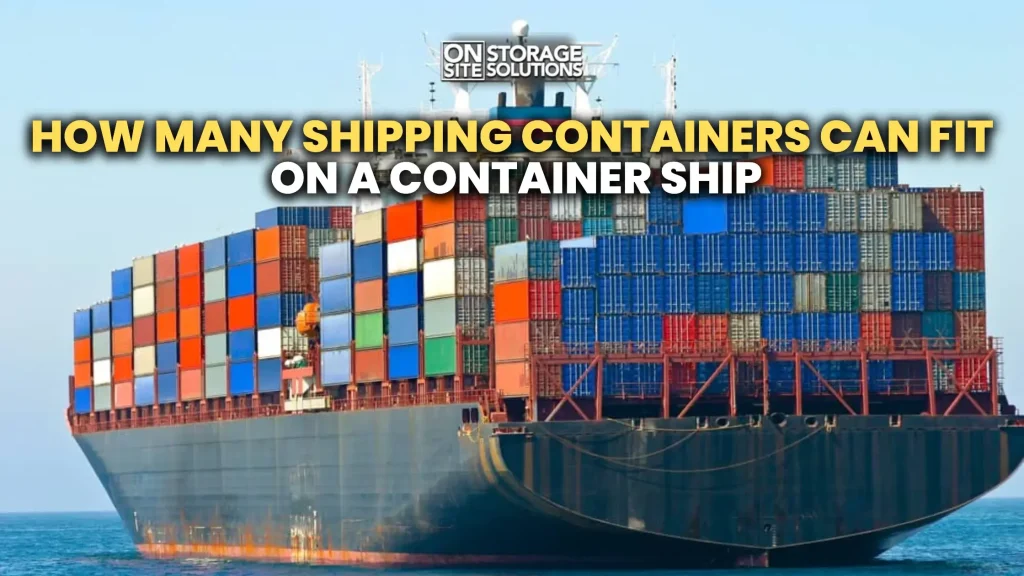

Knowing how many shipping containers can fit on a container ship highlights the scale of modern maritime trade. These massive vessels transport millions of products across the oceans every day, from electronics to furniture, keeping global commerce moving.
Container ships have grown in size and capacity over the decades, with the number of containers they carry depending on ship design, size, and the types of containers used.
Understanding Shipping Containers
Before exploring how many shipping containers can fit on a container ship, it’s important to understand what an intermodal container is and why it is essential for global trade. An intermodal container is a sturdy metal box designed to transport cargo securely across long distances.
These containers are built to withstand the harsh conditions of ocean travel while keeping goods safe from damage or theft, making them a key component of modern shipping and logistics.
Shipping Container Types and How Many Shipping Containers Can Fit on a Container Ship
Shipping containers come in a variety of types, and knowing the differences helps explain how many shipping containers can fit on a container ship. Standard containers are ideal for general cargo, while high cube containers provide extra height for oversized goods. Flat racks and open-top containers are designed for heavy or irregularly shaped items, allowing ships to carry diverse cargo efficiently.
By using the right container type, shipping companies can optimize space, maximize capacity, and ensure that every container ship carries as many containers as possible safely.
History of Shipping Containers
The concept of shipping containers dates back to the late 18th century, but modern intermodal containers were standardized in the 1950s. These containers revolutionized cargo transport by simplifying loading and unloading, reducing shipping times, and minimizing losses during transit.
Their standardized dimensions ensure that containers can be seamlessly transferred between ships, trucks, and trains. Understanding intermodal container dimensions helps explain why ships are built the way they are and how many containers they can carry.
The number of containers a ship can carry depends on several key factors, which affect how many shipping containers can fit on a container ship:
- Ship Size: Container ships range from small feeder vessels to ultra-large container vessels (ULCVs), capable of carrying tens of thousands of containers. Larger ships naturally have higher capacity.
- Ship Design and Weight Distribution: The ship’s design, deck layout, and number of container tiers determine how many shipping containers can be safely loaded. Proper weight distribution ensures stability and prevents tilting or capsizing. Advanced modeling allows shipping companies to maximize capacity safely.
- Container Size and Measurement: Containers mainly come in 20-foot (TEU) and 40-foot (FEU) sizes. Using the TEU standard, shipping companies can efficiently plan loading strategies and calculate exactly how many containers fit on a ship.
How Many Shipping Containers Can Fit on a Container Ship and the Largest Vessels Today
Modern container ships can carry between 10,000 and over 24,000 TEUs, depending on their class and size.
A. Small Feeder Ships
Smaller feeder ships are designed to service regional ports. These vessels can hold between 1,000 and 3,000 TEUs, ideal for transporting goods over shorter distances. Despite their smaller size, they play a critical role in connecting local markets to global trade networks.
B. Panamax and Post-Panamax Ships
Panamax ships are designed to pass through the Panama Canal, with a capacity of roughly 5,000 TEUs. Post-Panamax ships exceed Panama Canal dimensions and can carry 8,000 to 12,000 TEUs. These larger ships demonstrate the efficiency gained by scaling up container transport.
C. Ultra-Large Container Vessels (ULCVs)
Lorem ipsum dolor sit amet, consectetur
The biggest container ships in operation today are ULCVs, capable of carrying over 21,000 TEUs. Some of the most notable examples include the MSC Irina, MSC Tessa, and MSC Gülsün.
Real-World Examples of ULCVs
- Emma Maersk: Part of the Maersk Line Triple E-class, this ship can carry up to 14,770 TEUs. Its design prioritizes energy efficiency and cargo capacity.
- Ever Given: Famous for the Suez Canal incident, this ship can hold 20,124 TEUs, showcasing the massive scale of modern shipping.
- MSC Gülsün: With a capacity of 23,756 TEUs, this vessel demonstrates the engineering innovation behind ultra-large container vessels.
- MSC Irina: Currently the world’s largest container ship, the MSC Irina can transport over 24,300 containers, setting a record in maritime logistics.
- MSC Tessa: Holding 24,116 TEUs, this ship exemplifies how modern design allows shipping companies to transport vast quantities efficiently.
Understanding how many shipping containers can fit on a container ship not only highlights the scale of these vessels but also illustrates the importance of optimized cargo handling. Efficient loading and unloading, combined with smart container stacking, allows these ships to operate at full capacity without compromising safe
Intermodal Shipping and Container Flexibility
The efficiency of container ships is amplified by intermodal transport. An intermodal container is designed to be moved seamlessly between ships, trucks, and trains without unloading its cargo. This system reduces transit times, minimizes handling costs, and enhances supply chain reliability.
Using shipping container ramps at ports further simplifies the loading and unloading process. These ramps allow containers to be moved onto trucks or railcars directly from the ship, speeding up operations and reducing labor costs.
How Many Shipping Containers Can Fit on a Container Ship in the Future
The shipping industry continues to push the limits of container ship design. Engineers are developing vessels with even larger capacities, improved fuel efficiency, and environmentally friendly technologies. Advanced stacking systems, automated cargo handling, and real-time tracking of containers are helping shipping companies transport goods more efficiently than ever.
As global trade continues to grow, knowing how to efficiently load and manage containers is essential for logistics planning. Companies that optimize container loading can reduce shipping costs, improve delivery times, and gain a competitive edge in the marketplace.
Conclusion
Container ships are the backbone of global trade, and knowing how many shipping containers can fit on a container ship shows the massive scale of modern maritime logistics. From small feeder vessels to ultra-large ships, these giants move millions of products worldwide. Shipping containers, including standard, high cube, and open-top types, provide the security and flexibility needed for global commerce.
For businesses and individuals, On-Site Storage Solutions offers high-quality storage containers for on-site use, temporary storage, or transporting large volumes efficiently. Call (888) 977-9085 to find the perfect container solution and experience the same reliability that drives global trade.
FREQUENTLY ASKED QUESTIONS
Modern container ships can carry between 10,000 and over 24,000 TEUs depending on their size and class. Small feeder ships hold 1,000–3,000 TEUs, Panamax ships around 5,000 TEUs, Post-Panamax ships 8,000–12,000 TEUs, and ultra-large container vessels (ULCVs) can carry over 21,000 TEUs.
The Maersk Group is one of the largest owners of shipping containers globally, operating a vast fleet of container ships and managing millions of containers.
Currently, no container ship can carry 50,000 containers. The largest ships today, like the MSC Irina, hold just over 24,300 TEUs, which is roughly half of 50,000.
China has the largest container shipping fleet in the world, followed by other major maritime nations such as Greece, Japan, and Germany.
Container ships typically travel at speeds of 16–24 knots (about 18–28 mph), depending on their size, route, and fuel efficiency considerations.


