
Buy shipping containers for as low as $1,350.00! CALL US TODAY! (888) 977-9085

Rent shipping containers for as low as $95.00 a month. CALL US TODAY! (888) 977-9085
Rent-To-Own Shipping containers for as low as $79.99 a month. CALL US TODAY! (888) 977-9085
  • Buy
    • Buy Shipping Containers
    • Buy Refrigerated Shipping Containers
    • Modifications
    • Shipping Container Accessories
  • Rent
    • Shipping Container Rental
    • Rent Refrigerated Shipping Containers
  • Rent-To-Own
  • Locations
  • Resources
    • FAQ
    • Container Types
    • Container Conditions
    • Container Grades
    • Delivery Guide
    • Containers We Delivered
    • Tax Exemption
    • Blogs
  • Onsite Special
  • Why Onsite Storage
  • Buy
    • Buy Shipping Containers
    • Buy Refrigerated Shipping Containers
    • Modifications
    • Shipping Container Accessories
  • Rent
    • Shipping Container Rental
    • Rent Refrigerated Shipping Containers
  • Rent-To-Own
  • Locations
  • Resources
    • FAQ
    • Container Types
    • Container Conditions
    • Container Grades
    • Delivery Guide
    • Containers We Delivered
    • Tax Exemption
    • Blogs
  • Onsite Special
  • Why Onsite Storage
Onsite Storage Solutions Logo
$0.00 0 Cart
(888) 977-9085
(888) 977-9085
Onsite Storage Solutions Logo
$0.00 0 Cart

My Account

  • Buy
    • Buy Shipping Containers
    • Buy Refrigerated Shipping Containers
    • Modifications
    • Shipping Container Accessories
  • Rent
    • Shipping Container Rental
    • Rent Refrigerated Shipping Containers
  • Rent-To-Own
  • Locations
  • Resources
    • FAQ
    • Container Types
    • Container Conditions
    • Container Grades
    • Delivery Guide
    • Containers We Delivered
    • Tax Exemption
    • Blogs
  • Onsite Special
  • Why Onsite Storage
  • Buy
    • Buy Shipping Containers
    • Buy Refrigerated Shipping Containers
    • Modifications
    • Shipping Container Accessories
  • Rent
    • Shipping Container Rental
    • Rent Refrigerated Shipping Containers
  • Rent-To-Own
  • Locations
  • Resources
    • FAQ
    • Container Types
    • Container Conditions
    • Container Grades
    • Delivery Guide
    • Containers We Delivered
    • Tax Exemption
    • Blogs
  • Onsite Special
  • Why Onsite Storage

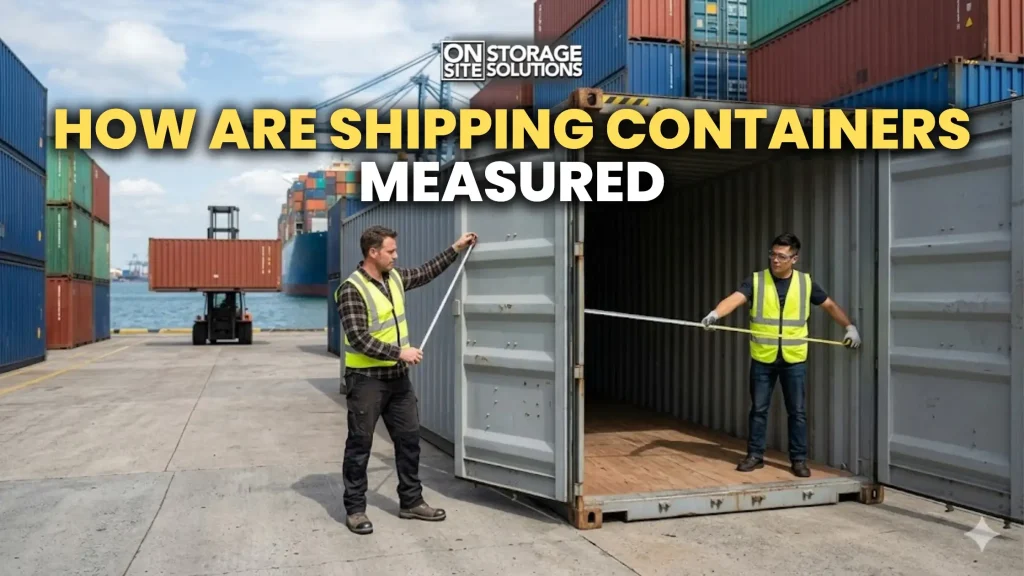
How Are Shipping Containers Measured

How are shipping containers measured using standard dimensions, volume, and container capacity specifications.

Understanding how are shipping containers measured is essential for anyone looking to buy, lease, or utilize these versatile storage units. Measuring a container may seem complex at first, but with the right approach, it becomes simple and straightforward. 

This guide will help you navigate the dimensions of shipping containers, both internally and externally, to ensure a perfect fit for your cargo, storage, or living needs.

Shipping Container Internal Measurements

Shipping container internal measurements showing length, width, and height used to determine cargo capacity.

When learning how are shipping containers measured, it is important to start with internal dimensions. Internal measurements refer to the usable space inside the container where cargo, equipment, or furnishings will fit.

  • Width is measured by taking the distance between the two longest interior walls. This measurement ensures that your cargo can fit comfortably without being forced.
  • Length is calculated from one end wall to the other on the inside. For standard containers, this is typically 20 feet or 40 feet, making 20 foot containers and 40 foot containers the most common options.
  • Height measures the vertical space from the floor to the ceiling of the container. Standard containers are about 8.5 feet tall, while high-cube models reach 9.5 feet, giving extra room for taller items.
shipping containers for sale newark

Door dimensions are also crucial. Door opening width should be measured between the support frames, allowing a small gap for smooth entry and exit. Door height is measured from the floor to the top of the frame, which may be slightly less than the internal height. This ensures that large items can pass through without obstruction.

Internal measurements are vital for planning cargo arrangement or converting a container into functional living or office space. Correct calculations help avoid overloading and make operations more efficient.

External Shipping Container Measurements

External shipping container measurements displaying standard container length, width, and height specifications.

Understanding how are shipping containers measured externally is equally important. External dimensions indicate if the container fits in a space or on a transport vehicle.

  • Length is measured from one end to the other on the outside of the container. Standard lengths of 20 feet and 40 feet correspond to commonly used container types in shipping logistics.
  • Width is measured across the narrow side, typically the same as the internal width unless modifications have been made.
  • Height is measured from the ground to the top of the container, which is important for clearance during transport or placement on a property.
 

External measurements help in planning stacking, movement, and lifting operations. They ensure the container can be placed on trucks, ships, or rails without obstruction. 

The design of an intermodal shipping container allows for seamless transfer across different transport methods, but accurate measurements are necessary for safety and efficiency.

Key Considerations for Understanding How Are Shipping Containers Measured

Key considerations for understanding how are shipping containers measured including dimensions, volume, and weight capacity.

Choosing the right container requires thoughtful consideration. Understanding how are shipping containers measured helps determine the best size for current and future needs.

How Are Shipping Containers Measured for Their Purpose

The intended use of a shipping container plays a key role in selecting the right dimensions. If you plan to ship goods, internal measurements must accommodate not just the cargo, but also packaging materials like boxes, pallets, or bubble wraps.

For personal or commercial conversions, such as creating an office, gym, or living space, you must account for furniture, equipment, and the number of users. High-cube containers offer extra height, making them ideal for vertical storage or standing space.b

shipping containers for sale dallas

Future Requirements

Planning for growth is essential. If you anticipate additional cargo, personnel, or equipment, it’s wise to select a container that allows expansion. A 40 foot container may be more suitable for long-term needs due to its increased capacity and flexibility.

How Are Shipping Containers Measured for Versatility

Containers are highly adaptable. Some may serve as temporary storage units, while others are converted into offices, workshops, or homes. Choosing a container with enough room for future adjustments ensures versatility. High-cube containers, for example, offer additional space for vertical modifications or shelving.

Shipping Container Types and Variations

Different shipping container types and variations measured according to industry standards.
  1. Common shipping container types
  • Standard containers usually come in 20-foot and 40-foot lengths
  • High-cube containers are similar but provide an extra 1 foot of height
  • Specialty containers are designed for specific cargo needs, such as:
    • Refrigerated containers (reefers) for temperature-sensitive goods
    • Flat rack containers for oversized or heavy cargo
    • Open-top containers for items that need to be loaded from above
 
  1. Shipping container other names
  • Shipping containers are also known as:
    • Conex boxes
    • Sea cans
    • Cargo boxes
  • Even though they go by different names, they are all built to comply with uniform global sizing standards, ensuring consistency in dimensions worldwide.
  • Naming differences may still affect how people describe dimensions and usage
 
  1. Materials and durability
  • Most containers are made from weathering steel
  • This material is designed to:
    • Resist rust and corrosion
    • Withstand harsh weather conditions
  • Because of this, containers are:
    • Highly durable for international shipping
    • Commonly used for long-term outdoor storage
shipping containers for sale las vegas

Practical Tips for Accurate Measurements

Practical tips for accurate shipping container measurements using industry best practices.

When measuring your container, use a tape measure for precision. Always record internal and external dimensions separately, and note the height and width of the doors. These details matter when planning for cargo entry or creating customized spaces.

Avoid estimating dimensions, as even a few inches can impact logistics and usability. For multi-container projects, consider documenting each container’s measurements in a chart for easy reference.

Exploring How Are Shipping Containers Measured for Uses Beyond Cargo

How are shipping containers measured for storage, housing, office spaces, and other alternative uses.

Containers are no longer limited to transporting goods. Understanding how are shipping containers measured enables creative applications, including portable offices, pop-up shops, tiny homes, and workshops. Accurate measurements ensure functionality and maximize usable space.

For instance, a shipping container converted into a small office must allow space for desks, chairs, and storage. A gym conversion requires additional height for equipment like treadmills or weight racks. Accurate measurement planning prevents costly mistakes and ensures a smooth transformation.

rent-to-own shipping containers

Conclusion

Summary of how are shipping containers measured using dimensions, volume, and capacity standards.

Learning how are shipping containers measured is key for anyone using them for storage or shipping. By checking internal and external dimensions, door sizes, and container type, you can choose the right fit for your needs.

Shipping containers are highly versatile. Used for transporting goods, personal storage, or creative projects, accurate measurements ensure safety, efficiency, and usability.

On-Site Storage Solutions offers a wide range of new and used containers, from 20 foot containers to 40 foot containers. Call (888) 977-9085 to find the right container for your project.


Dry Van Containers For Sale

FREQUENTLY ASKED QUESTIONS

1. How do you measure a shipping container?

 To measure a shipping container, check both internal and external dimensions:

  • Internal: Measure width (longest side), length (shortest side), and height (floor to ceiling). Don’t forget the door width and height.
  • External: Measure the length, width, and height from the outside of the container. This ensures it fits in its intended space and for transport.
2. What are standard shipping container sizes?

 The most common standard sizes are 20 foot containers and 40 foot containers. Heights vary:

  • Standard: 8.5 feet tall
  • High-cube: 9.5 feet tall for extra vertical space
 

Width is generally about 8 feet, consistent across most containers.

3. What's the difference between 20ft & 40ft containers?
    • 20ft container: Shorter, easier to move, ideal for smaller shipments or storage.
    • 40ft container: Twice the length, provides more storage or living space, ideal for larger cargo or office/living conversions.
     

    High-cube options are available for both sizes, adding extra height.

4. What does L × W × H mean?

 L × W × H refers to the Length × Width × Height of the container.

  • Length (L): Longest side
  • Width (W): Narrow side
  • Height (H): From floor to ceiling (internal) or ground to top (external)
 

It’s the standard way to define container size for storage or shipping.

5. What size is a 20ft container?

 A 20ft container typically measures:

  • Inside dimensions: approximately 19 feet 4 inches in length, 7 feet 8 inches in width, and 7 feet 10 inches in height
  • Outside dimensions: roughly 20 feet long, 8 feet wide, and 8 feet 6 inches tall
 

High-cube versions add about 1 foot in height for extra vertical space.

PrevPreviousWhat Is The Floor Of A Shipping Container Made Of?
NextSurprise Your Mom on Mother’s Day with a Shipping Container PoolNext
  • May 10, 2023
  • By Gregg Schoenborn
  • Blog, How to...

Where to Buy Used Cargo Containers for Storage Solutions

July 16, 2026
What are the Most Reliable Cargo Container Rental Services in the US?

What are the Most Reliable Cargo Container Rental Services in the US?

July 15, 2026
Local Used Shipping Containers: Buy Locally vs Online

Local Used Shipping Containers: Buy Locally vs Online

July 13, 2026
Search

Related Blog Post

Where to Buy Used Cargo Containers for Storage Solutions

If you are wondering where to buy used cargo containers, there are several reliable options available for personal, commercial, and industrial storage needs. Used cargo

Read More »
July 16, 2026 No Comments
What are the Most Reliable Cargo Container Rental Services in the US?
Blog

What are the Most Reliable Cargo Container Rental Services in the US?

Cargo container rentals have become a practical storage solution for businesses seeking secure, flexible, and cost effective space for equipment, inventory, and materials. Businesses in

Read More »
July 15, 2026 No Comments
Local Used Shipping Containers: Buy Locally vs Online
Blog

Local Used Shipping Containers: Buy Locally vs Online

The demand for local used shipping containers continues to grow as businesses and property owners seek cost-effective storage solutions. These containers are widely used for

Read More »
July 13, 2026 No Comments
Portable Storage Container Company Guide and Tips
Blog

Portable Storage Container Company Guide and Tips

Choosing the right portable storage container company is a key step when investing in a shipping container for storage or worksite use. Not all containers

Read More »
July 10, 2026 No Comments
Alternative Storage: Smarter Option Than Self-Storage
Blog

Alternative Storage: Smarter Option Than Self-Storage

Alternative storage is becoming a practical solution for people who need more than temporary space. Instead of paying monthly self-storage fees that only provide short-term

Read More »
July 8, 2026 No Comments
Shipping Container Financing: What to Expect and How to Qualify
Blog

Shipping Container Financing: What to Expect and How to Qualify

Shipping container financing is becoming a preferred method for businesses and individuals who need fast access to storage and workspace solutions without the limitations of

Read More »
July 6, 2026 No Comments

SUBSCRIBE TO OUR NEWSLETTER TO RECEIVE THE LATEST NEWS AND EXCLUSIVE OFFERS

Captcha validation failed. If you are not a robot then please try again.
Onsite storage solution logo footer

Navigation

  • Blog
  • Locations
  • Type of Containers
  • Conditions
  • Why Onsite Storage
  • Get a Quote
  • Blog
  • Locations
  • Type of Containers
  • Conditions
  • Why Onsite Storage
  • Get a Quote

Resources

  • Sizes
  • Gallery
  • FAQ
  • Reviews
  • Privacy Policy
  • Terms and Conditions
  • Refunds and Returns
  • Shipping Policy
  • Sizes
  • Gallery
  • FAQ
  • Reviews
  • Privacy Policy
  • Terms and Conditions
  • Refunds and Returns
  • Shipping Policy

Contact Us

  • 888-977-9085
  • info@OnSiteStorage.com
  • PO Box 1051 Wildomar, CA 92595

Follow Us

Facebook Page Instagram Page Youtube Channel Linkedin  Page Pinterest Page Google Business Page

Ⓒ 2025 On-site Storage Solutions | All Rights Reserved

secured-payments

(888) 977-9085
Call before you buy. Best prices by phone!

Let's get you the best price.

We use your location to show accurate pricing and availability in your area.